The Indian monsoon has shifted over the past quarter century. Northwest India now receives substantially…
Read More →
The Indian monsoon has shifted over the past quarter century. Northwest India now receives substantially…
Read More →
How much is darkness worth? At Chile’s Paranal Observatory, it can mean the difference between…
Read More →
The US has inflicted $10tn in global damages since 1990 through its vast planet-heating emissions, new…
Read More →
Letters to US Federal Communications Commission raise concerns over tech firms’ plans to use reflective…
Read More →
Earth is struggling with a record energy imbalance with warming oceans to unprecedented levels and…
Read More →
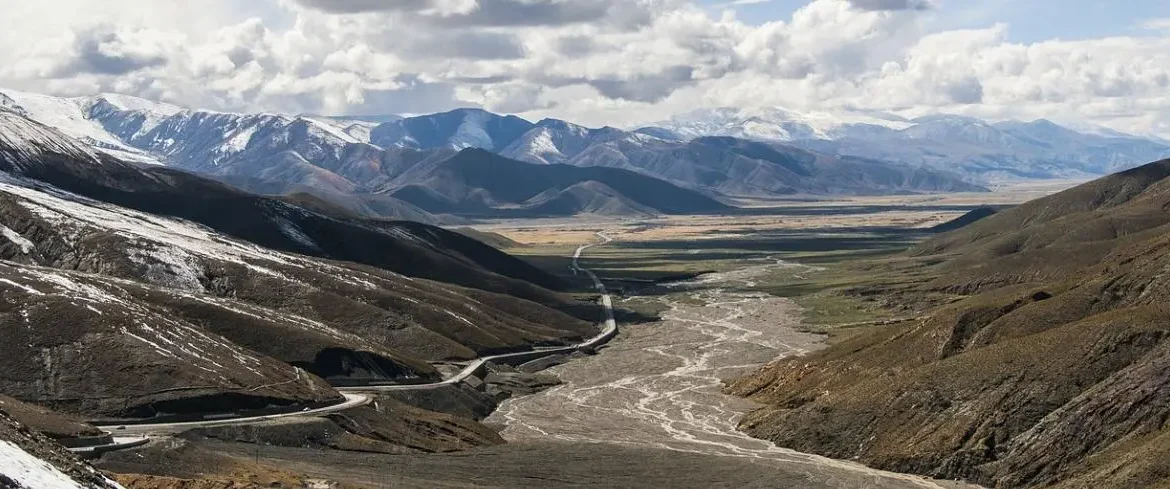
A new study in Nature Communications discovers a gloomy climate tipping point in Tibetan permafrost ecosystems. Warming of 2–4 degrees Celsius triggers a self-reinforcing cycle of carbon release that could significantly accelerate climate change, according to the work.
Permafrost covers roughly 15% of the Northern Hemisphere’s land surface. It is ground that remains frozen for at least two years. For millennia, organic matter has been trapped in frozen ground, kept out of the atmosphere as a vast carbon reserve.
As global temperatures rise, however, that carbon bank is increasingly springing leaks. Warming thaws the frozen ground, allowing microbes to break down the stored organic matter and release it back into the atmosphere as CO2, a feedback loop that could significantly amplify climate change. But at what warming level does this process cross a point of no return, where carbon losses permanently outpace carbon gains?
Phys.org spoke with Professor Jinzhi Ding of the Institute of Tibetan Plateau Research, Chinese Academy of Sciences, and co-author of the study, to understand what drove the research and what the findings mean for our understanding of climate feedback.
«Old-carbon decomposition was essentially a ‘black box’ because we lacked the tools and long-term observations to track it,» she told Phys.org. «That unanswered question motivated us to finally open that black box.»
The Tibetan Plateau is home to the world’s largest alpine permafrost carbon reservoir, with roughly 47 billion tons of carbon present in the top 10 meters of soil alone. The plateau is warming at approximately 2.5 times the global average rate, making it a testing ground for understanding the effects of rising temperatures on permafrost ecosystems worldwide.
The problem centers on a delicate balance between two competing processes. Plants initially thrive with a slight increase in temperature resulting in them pulling more CO2 from the atmosphere through photosynthesis. But it simultaneously accelerates microbial decomposition in the soil, releasing carbon back into the atmosphere. The critical unknown was which process ultimately wins and at what temperature the balance breaks irreversibly.
What made this particularly difficult to answer was the role of ancient carbon locked deep in permafrost soils. Once thawed, carbon frozen for hundreds to thousands of years enters the atmosphere as entirely «new» emissions—not simply recycled modern plant carbon, but a net addition that existing climate models have struggled to account for.
For Ding, the question was personal.
«During my Ph.D., our research showed that the Tibetan Plateau had been continuously greening under climate change,» she said. «But since around the 2000s, carbon sinks in permafrost regions had stopped increasing. If vegetation productivity was still increasing, why was the carbon sink no longer growing?»
To address Ding’s question, the team conducted a multi-level warming experiment at an alpine meadow site in Anduo County, central Tibet, at an elevation of 4,790 meters. In other words, they simultaneously simulated four climate scenarios using precisely controlled overhead infrared heaters: ambient temperature, and one, two, and four degrees Celsius above ambient. This allowed them to directly compare ecosystem responses across a range of warming levels and pinpoint where critical thresholds emerge.
Over five years, they collected more than 40,000 hourly CO2 flux measurements using automated transparent chambers. But what set this experiment apart was a vertically resolved soil gas monitoring system that tracked CO2 concentrations and carbon isotope signatures at five depths, from 10 cm to 160 cm underground.
The isotope signatures acted as a fingerprint, allowing the team to distinguish whether the CO2 being released came from recently decomposed plant matter or from ancient, previously frozen carbon.
«This allowed us to capture both the short-term dynamics and long-term trends of carbon uptake and carbon release much more realistically than conventional periodic measurements,» explained Ding.
Warming by +1°C, +2°C, and +4°C increased annual net CO2 release by 44%, 80%, and 176%, respectively, and the site was a net carbon source before any experimental warming began.
«When warming reaches around 2–4°C, the system changes fundamentally,» Ding told Phys.org. «Plants begin to reach their thermal and water-stress limits, so photosynthesis declines. At the same time, thaw penetrates deeper into the soil, exposing old permafrost carbon that has been frozen and protected for hundreds to thousands of years. Once thawed, microbes can decompose it and release it as CO2.»
Projecting these findings to end-of-century warming levels (estimated at 2.69 degrees Celsius for Tibetan permafrost regions), the team calculated this could release 24–47 grams of CO2 per square meter per year of ancient carbon alone. Ding cautioned that this estimate is based on a single site and should be interpreted carefully, but noted that carbon-rich high-latitude permafrost regions could see even higher emissions due to greater carbon stocks.
The findings carry implications well beyond the Tibetan Plateau. Current Earth system models largely fail to account for depth-resolved carbon dynamics and the mobilization of ancient carbon. In other words, projections of permafrost carbon feedback may be significantly underestimated.
Ding pointed to several directions for future research.
«Future research should refine the exact tipping-point temperature using finer warming gradients, since our experiment identified the threshold within a 2–4°C range but not the precise point,» she explained. «Integrating these mechanisms into Earth system models is also crucial to improving global climate projections.»
The researchers also note that the five-year duration of the experiment, while substantial, limits inference about longer-term trajectories. Plant communities may gradually shift toward more heat-tolerant species, and microbial communities may adapt over time, both of which could partially offset carbon losses in ways the experiment was unable to capture.